Skip hire is one of the services we added because customers kept asking for it. If you are ordering blocks and plasterboard for a kitchen extension in Beeston, it makes sense to book the skip for the old kitchen at the same time, from someone who knows what else is arriving on the drive that week. Below is what you need to know before you book: which of the standard UK skip sizes suits your job, when you need a council permit in Nottingham, what cannot go in a skip, and how to fill one so it can be collected. Sizes and hire periods are confirmed when you book, so ring 0115 929 2350 with your address and a description of the waste and we will give you a price.
On this page
- 1.How skip hire through the yard works
- 2.Skip sizes explained
- 3.Which size for which job
- 4.Skip permits in Nottingham: on the road or on the drive
- 5.What can and cannot go in a skip
- 6.Where to put the skip and access for the lorry
- 7.Filling it properly: level loads, weight and hire periods
- 8.Skips alongside materials, concrete and tool hire
- 9.Frequently asked questions
How skip hire through the yard works
We are a builders merchant first, and the skip is one of the services we arrange for customers rather than a separate business with its own phone line. In practice that makes things simpler for you: the same person who takes your materials order books the skip, knows when the concrete is coming and can make sure the skip is not sitting exactly where the crane lorry needs to stand.
Booking works like this:
- Tell us about the job. The address, what the waste is (rubble, soil, plasterboard, old kitchen, garden waste, general renovation mix), roughly how much, and whether the skip will sit on your drive or on the road.
- We suggest a size. Based on what you describe, we will recommend one of the standard sizes below and tell you which are available for your job. If the waste is heavy, rubble and soil for instance, that changes what we suggest.
- We confirm the price, the delivery day and the hire period. If the skip is going on the highway, we sort out the permit question at the same time; see the permits section.
- The skip arrives, you fill it, you ring us when it is full and we arrange collection. If you need it longer, or need it swapped for an empty one, say so.
A few things to be clear about. We do not publish a price list for skips, because the cost depends on size, waste type, location and whether a permit is needed, and we would rather quote you the real figure than a headline one. We also do not claim to keep every size in the list below on the yard; ask which are available for your job and we will confirm when you book. What we will always do is give you a straight answer and a single price that includes the skip, delivery, collection and disposal.
Skip hire sits alongside tool hire, cutting and concrete delivery under services on the homepage.
Skip sizes explained
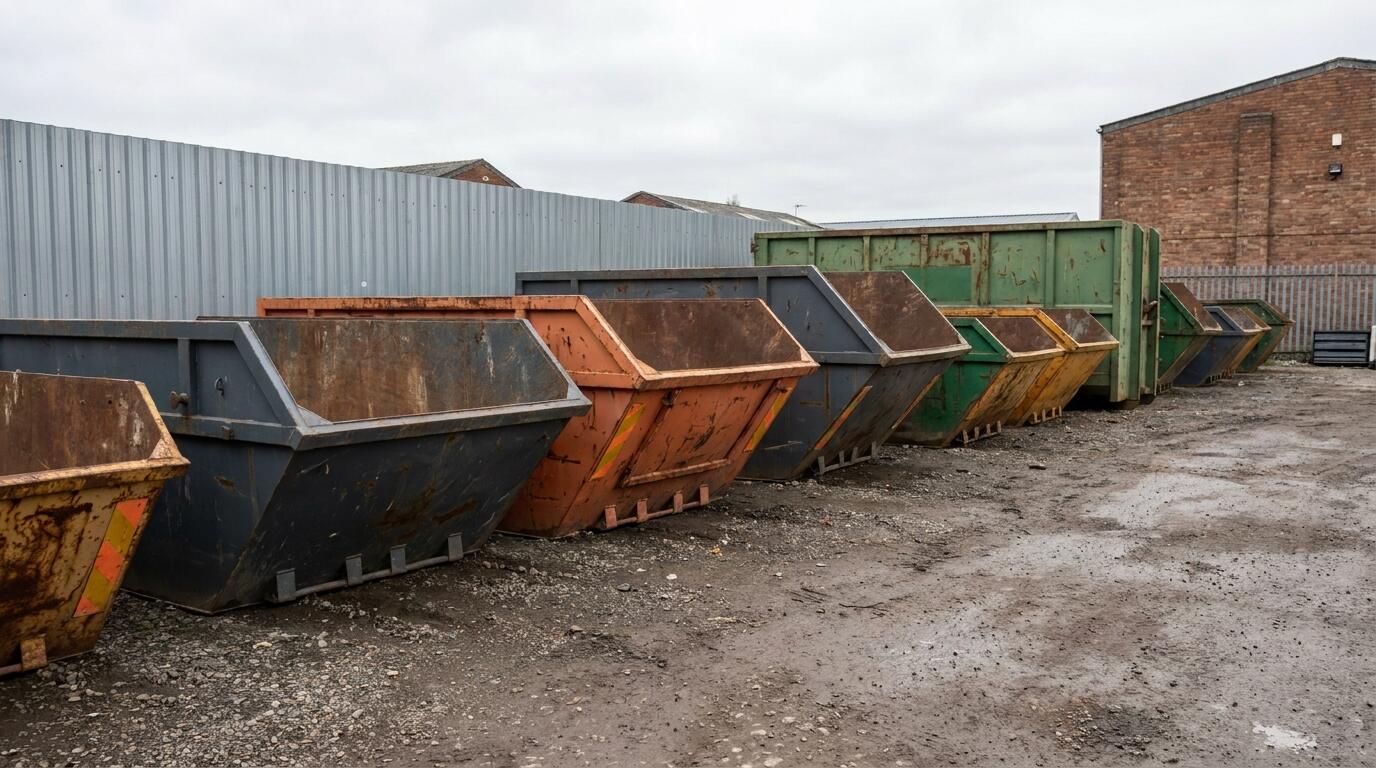
Skips in the UK are measured in cubic yards, and most operators run a range that goes from a 2 yard mini skip to a 12 yard maxi skip, with 6 and 8 yard builders skips the everyday workhorses. Dimensions vary slightly from one operator to another, so treat these as typical rather than exact.
| Size | Approx. dimensions (L x W x H) | Roughly holds | Suits |
|---|---|---|---|
| 2 yard mini | 1.5 x 1.2 x 0.9m | 20 to 25 bin bags | Small garden clear-out, one-room refit, small bathroom |
| 4 yard midi | 1.8 x 1.3 x 1.0m | 30 to 40 bin bags | Kitchen or bathroom refit, small landscaping job, garage clear-out |
| 6 yard builders | 2.6 x 1.5 x 1.2m | 50 to 60 bin bags | The standard builders skip: renovations, rubble, soil, mixed site waste |
| 8 yard builders | 3.4 x 1.7 x 1.2m | 60 to 80 bin bags | Larger renovations and extensions, bigger volumes of rubble |
| 12 yard maxi | 3.7 x 1.8 x 1.7m | 100 to 120 bin bags | Light, bulky waste: house clearance, shopfitting, packaging. Not soil or rubble |
Two points that trip people up. First, big skips are for light waste. A 12 yard skip full of rubble would weigh more than a skip lorry can lift, so operators restrict the large sizes to bulky, lightweight material and limit heavy waste to the 8 yard size and below, sometimes with a weight cap even on those. If your job is producing soil, concrete or hardcore, expect to be steered to a 6 or 8 yard skip and to fill it level, not heaped.
Second, the "bin bags" figure is a guide for household waste. A 6 yard skip takes roughly the rubble from a small single-storey extension's footings, or a kitchen and a bathroom together with the plaster off the walls, or a decent-sized garden strip-out. When in doubt, go one size up: the difference in price between two sizes is far smaller than the cost of a second skip. Ask which sizes are available for your job and we will confirm when you book.
Which size for which job
Most Nottingham jobs fall into a few recognisable patterns, and the size question usually answers itself once you describe the work.
- Bathroom refit in a terrace in Radford or Hyson Green: old suite, tiles, a bit of plasterboard and packaging. A 4 yard midi usually does it; a 2 yard mini if the tiles are staying.
- Kitchen refit: units, worktops, old appliances, tiles, plaster. A 4 yard is tight; a 6 yard gives room for the wall that came down as well.
- Single-storey extension on a 1930s semi in Wollaton or Aspley: footing spoil, a knocked-through wall, old patio, packaging over several weeks. A 6 or 8 yard, often swapped once or twice over the job. Talk to us about phasing it with the materials deliveries; the building supplies delivery page explains how we sequence a job.
- Garden makeover: old fencing, a concrete path, soil from levelling, a shed. Soil is heavy, so a 6 yard for the spoil and a separate light-waste skip for the fence and shed can work out cheaper than one big mixed skip.
- House clearance or loft clear-out in Sherwood, Carrington or West Bridgford: furniture, carpets, boxes, the contents of a garage. Bulky and light, so a 12 yard maxi if it will fit on the drive, otherwise an 8 yard swapped.
- Re-roof: old tiles and battens. Concrete tiles are heavy; a 6 or 8 yard filled level. Clay tiles and slate can often be sold on or reused, so think before you throw them in. Our roofing supplies page covers matching if you are keeping some.
- Landlord turnaround between tenants: a 4 or 6 yard, and a regular arrangement if you have several properties.
Where the skip will go affects the size as much as the waste does. A 12 yard skip is nearly four metres long and will not fit on a short drive in a terrace; an 8 yard on the road needs a permit and a parking space to itself. Measure the space, tell us what you have, and we will match a size to it, or suggest two smaller skips in sequence if that is what the access allows.
Skip permits in Nottingham: on the road or on the drive
If a skip sits entirely on private land, your drive or front garden, no permit is needed. If any part of it sits on the public highway, which includes the road, the pavement and a grass verge, a permit is required under the Highways Act, and placing a skip without one is an offence for the person who put it there and the operator.
Who issues the permit depends on where you are, because greater Nottingham is split between councils:
- Nottingham City Council is the highway authority within the city boundary, which covers Bobbers Mill, Basford, Bulwell, Hyson Green, Radford, Aspley, Bilborough, Strelley, Sherwood, Carrington, Wollaton, Clifton and the city centre.
- Nottinghamshire County Council handles highways for the surrounding districts: Beeston, Nuthall, Kimberley and Stapleford in Broxtowe; Arnold and Carlton in Gedling; West Bridgford in Rushcliffe; Hucknall in Ashfield.
In practice, highway permits are normally applied for by the skip operator rather than by the householder, and the cost is added to the hire. Permits are issued for a fixed period, so it pays to book the skip for when you are actually ready to fill it rather than leaving it on the road for a fortnight before work starts. Tell us the skip will be on the road when you book and we will explain how the permit is handled for your address and what it adds.
A skip on the highway also has conditions attached: it must have reflective markings on the ends, be lit at night with lamps or cones, carry the operator's name and number, and not be placed on double yellow lines, in a bus stop, over a manhole or where it blocks sight lines at a junction. If your street has residents' parking or is on a bus route, say so, because it can affect whether a permit will be granted and how long it takes.
The same rules apply to building materials left on the pavement, so if a pallet of bricks is going to sit on the road as well as a skip, the licence question covers both. It is nearly always easier to find room on the drive.
What can and cannot go in a skip
Most building and household waste is fine in a general skip. A short list of things is not, either because it is hazardous, because the law requires it to be handled separately, or because the disposal site will refuse the whole skip if they find it.
Generally fine:
- Bricks, blocks, concrete, tiles, hardcore and soil (in the sizes that can take heavy waste)
- Timber, doors, old kitchen units, furniture and carpets
- Metal, plastic, packaging and cardboard
- Garden waste, turf and old fencing
- Bagged household rubbish from a clearance
Not allowed in a general skip:
- Asbestos in any form, including old cement sheet garage roofs, soffits and Artex containing asbestos. It needs licensed removal and disposal.
- Plasterboard and gypsum products mixed with other waste. Gypsum must be kept separate from general waste at landfill, so plasterboard either goes in a dedicated plasterboard skip or bagged separately by arrangement. Ask when you book; a kitchen strip-out usually produces some.
- Gas cylinders. Never put a gas bottle in a skip, empty or not. Calor cylinders belong to Calor and can be returned to any stockist; bring yours to the yard and the bottle exchange page explains what happens to it.
- Fridges, freezers and air-conditioning units, which contain refrigerant gas.
- Televisions, monitors and other electrical goods covered by WEEE rules.
- Tyres, vehicle batteries and other batteries.
- Liquids of any kind: paint, solvents, oil, fuel and part-full tins. Dried-out empty paint tins are usually acceptable.
- Fluorescent tubes and low-energy bulbs, which contain mercury.
- Medical or clinical waste, and anything hazardous or chemical.
If a prohibited item is found in a skip at the transfer station, the operator faces a charge for sorting or rejecting it and that charge is passed back. If you are unsure about something, ask before it goes in. Nottingham's household waste recycling centres take most of the awkward items on this list free of charge for residents, which is often the simplest route for a fridge or a few tins of paint.
Where to put the skip and access for the lorry
A skip lorry is a big vehicle. It needs to get to your property, stand roughly in line with where the skip will sit, and lift the skip on and off with its arms, which need clearance above and behind. Thinking about this before you book saves the driver arriving and leaving with the skip still on the lorry.
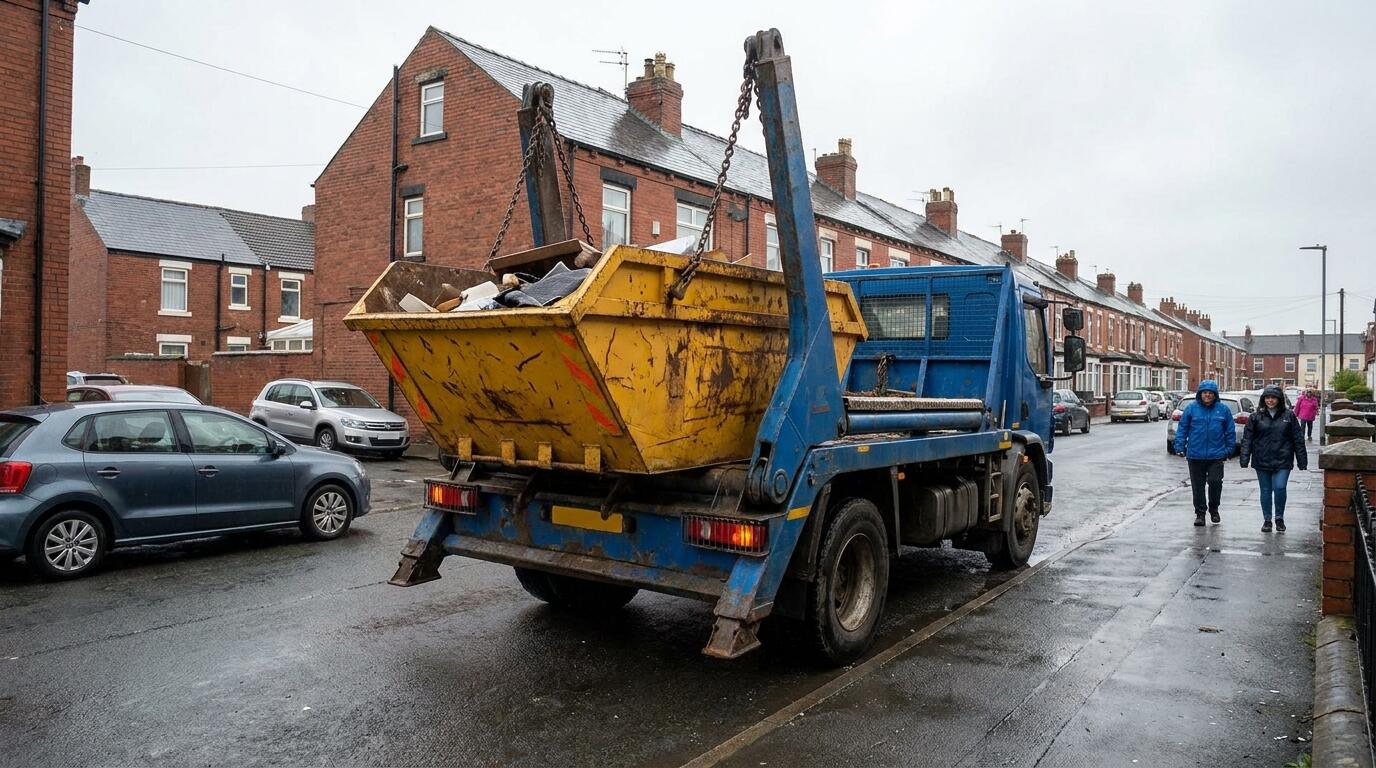
- Room to stand. The lorry needs something like 3 metres of width and a clear run to reverse in. Narrow terraced streets in Radford, Basford or Hyson Green with cars both sides can be a problem at busy times; a skip delivered early in the morning before the street fills up usually works.
- Height. The lifting arms rise well above the lorry, so overhead cables, tree branches and a low porch or carport roof over the drop point all matter. Tell us if there is anything above the space.
- Ground. The skip is set down on its runners and the lorry may need to put wheels on the drive. Block paving on a poor base, a tarmac drive on a hot day and a soft lawn can all be marked. Boards under the runners help on a drive you care about.
- Gates and width. A skip will not go through a standard garden gate. If the only space is a rear garden reached by a side passage, a skip is not the answer; talk to us about alternatives.
- Leave it reachable. Once the skip is down, do not park a car in front of it or build a materials stack round it. The lorry needs the same access to collect it that it needed to deliver it.
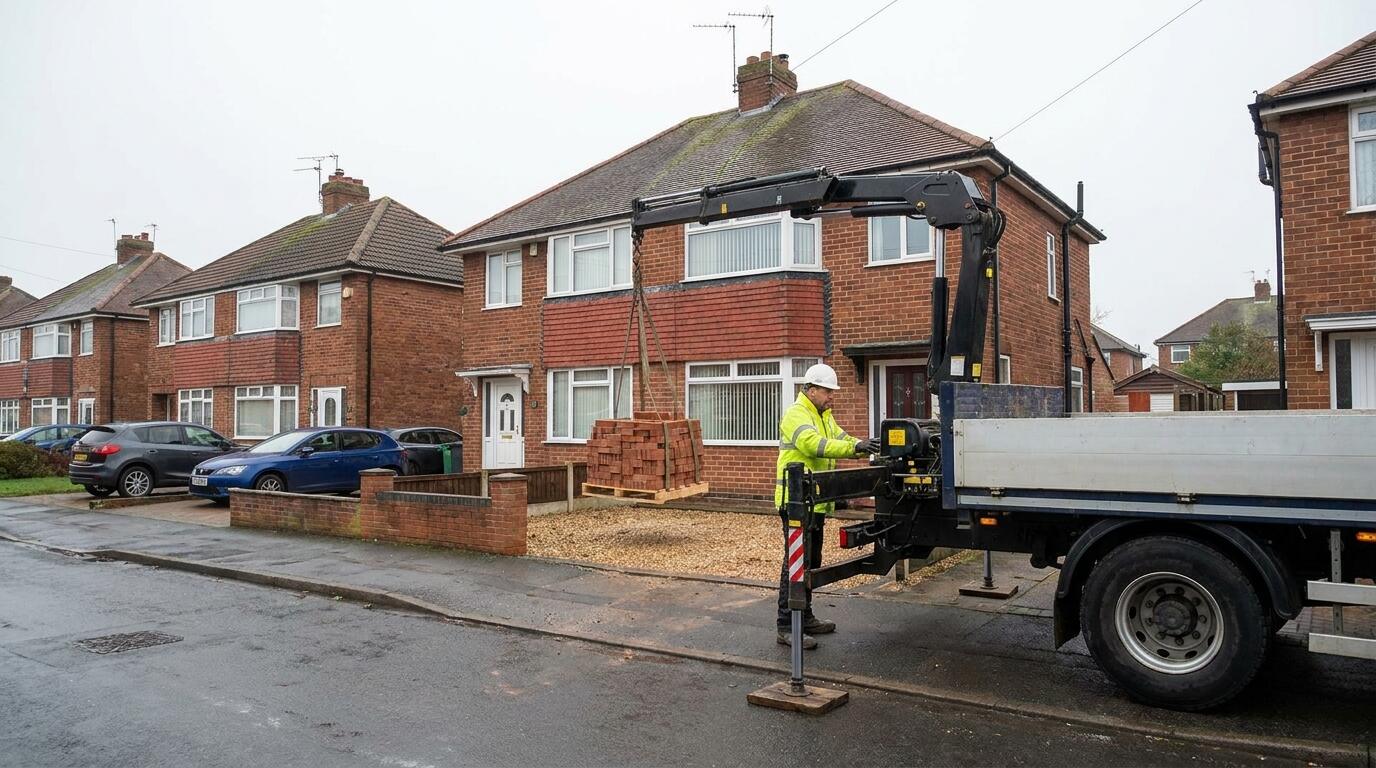
Where possible, put the skip on the drive rather than the road. It avoids the permit, it is safer for other road users, and it is under your eye. Where it has to go on the road, pick the spot when you book so the permit is for the right place, and keep that space clear with cones or a car until the lorry arrives. If the skip is part of a bigger job with materials arriving too, plan the drive as a whole: skip at one side, a clear landing area for the crane lorry at the other, and a path between them for the wheelbarrow.
Filling it properly: level loads, weight and hire periods
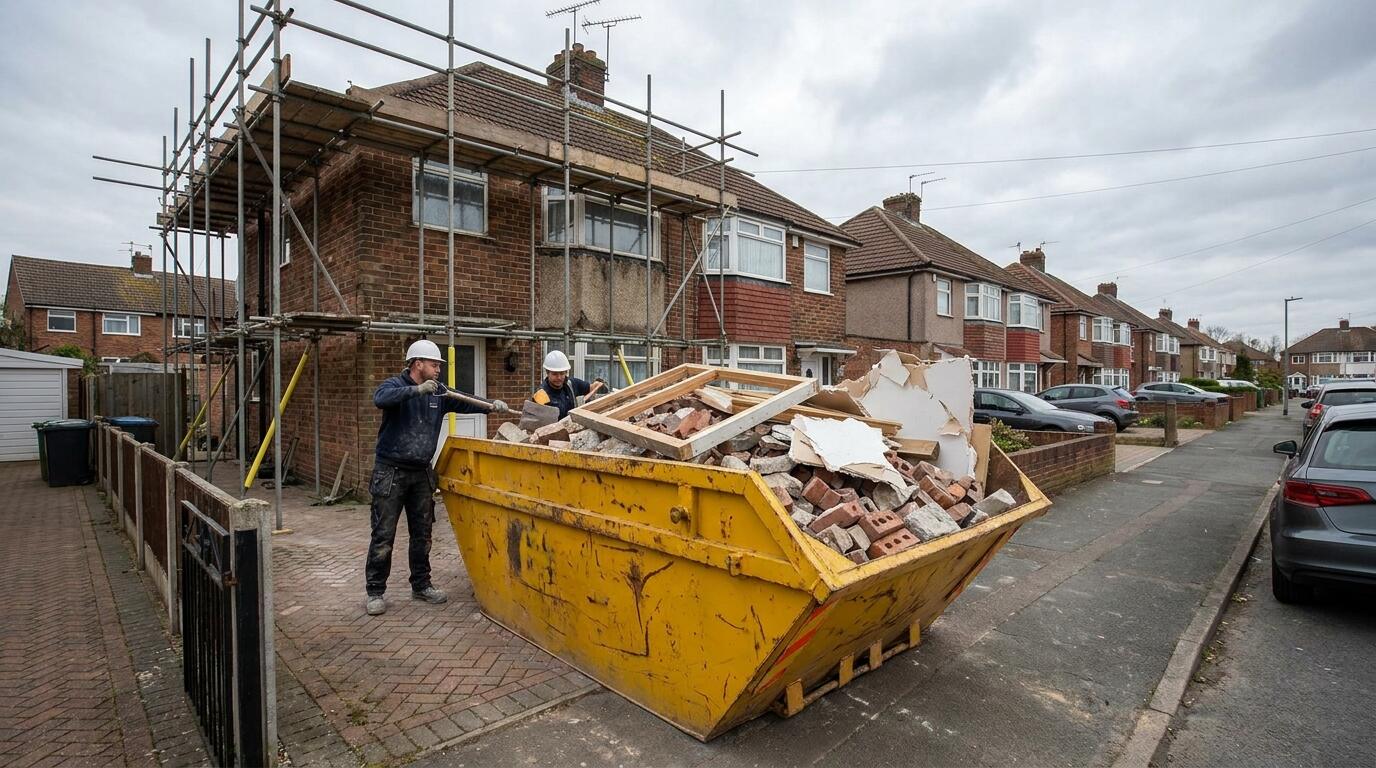
The rule that matters most is the level load. A skip must be filled no higher than the top of its sides so it can be lifted, sheeted and driven legally. An overfilled skip will not be collected until the excess is removed, and that is a wasted trip that gets charged. Fill it flat, not into a mound.
A few habits that get more into the skip and avoid problems at collection:
- Break things down. Flat-pack the old kitchen units, cut up the carpet, take the doors off. Air is the most expensive thing you can put in a skip.
- Heavy at the bottom, light on top. Rubble and soil first, timber and bagged waste on top. It packs better and it keeps the load stable.
- Fill the ends. The corners and the far end of a skip are where most of the wasted space is.
- Watch the weight. A cubic metre of rubble or soil weighs around 1.5 to 2 tonnes. Fill an 8 yard skip to the brim with hardcore and it is beyond what the lorry can lift. If your waste is heavy, keep the load level and ask about any weight limit when you book.
- Keep out the rain if you can. A tarpaulin over soil or plasterboard stops it soaking up water and gaining weight, and stops neighbours adding their own contributions overnight, which is a genuine problem on some streets.
Hire periods are agreed when you book. Operators generally allow a standard period with the option to extend, and a skip on the road is tied to the permit dates as well. Tell us how long the job will take and whether you want the skip swapped for an empty one part way through; a builder on a six-week extension in Bilborough will want a different arrangement from a homeowner clearing a garage in Bulwell on a Saturday.
When it is full, ring us and we will arrange collection. If there is a delay at your end, let us know rather than leaving it; a skip that has sat full on a road for a week past its permit is the kind of thing that gets noticed.
Skips alongside materials, concrete and tool hire
The reason to book a skip through a builders merchant rather than from a leaflet through the door is that a skip is rarely the only thing a job needs, and the timing of everything else depends on it.
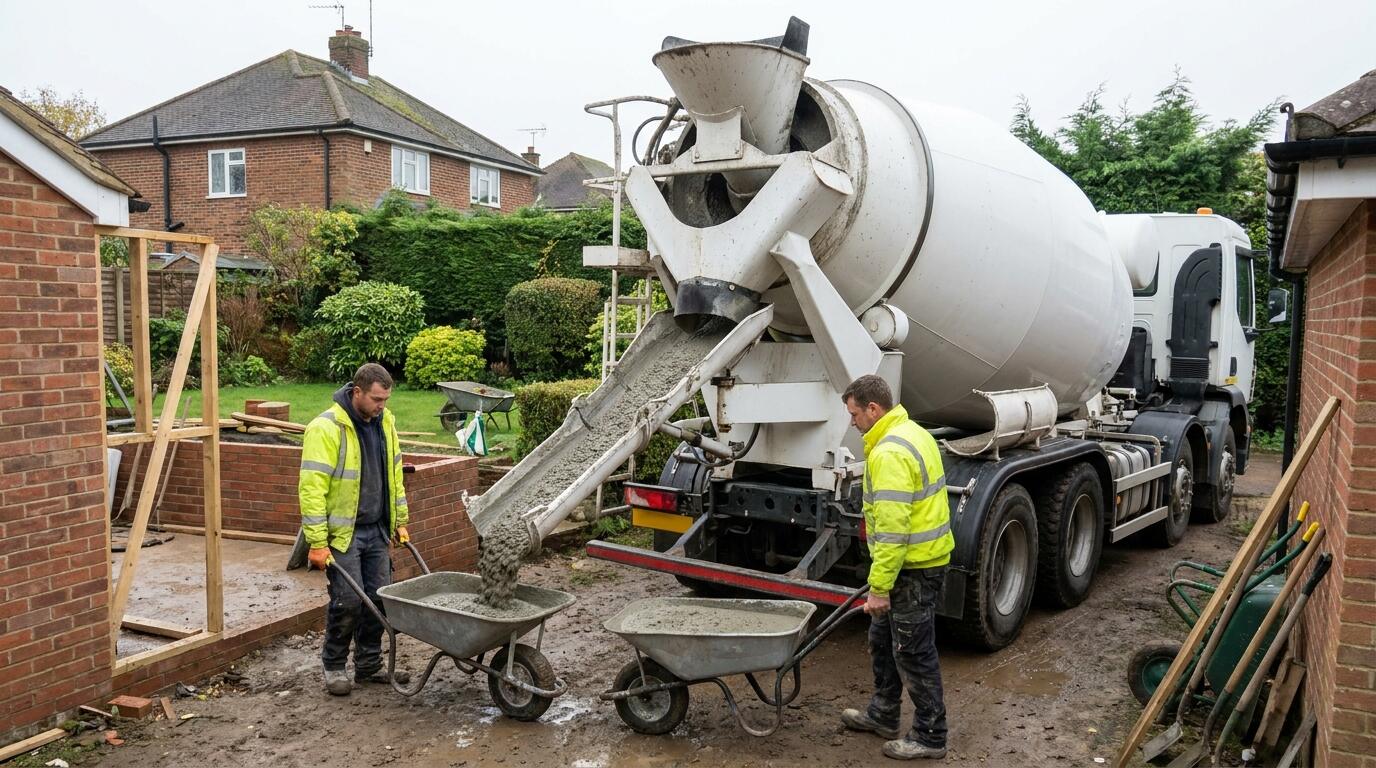
Take a typical rear extension in Wollaton or Sherwood. The skip arrives first, for the old patio and the wall that is coming out. The footings are dug and the spoil goes in the skip, which is probably full by the end of the first week and needs swapping. Then the ready-mix concrete comes for the trenches, and the mixer needs somewhere to stand that is not where the skip is. The blocks, sand and cement arrive on a crane lorry that needs its own patch of drive. Later the plasterboard turns up, and the offcuts and packaging fill a final skip. Booked through one counter, that sequence gets planned; booked through four suppliers, it gets argued over on the drive.
We can add to the same order:
- Building materials delivered in phases to match the build, priced with delivery. See the building supplies delivery page.
- Ready-mix concrete for footings, slabs and bases.
- Tool hire: a breaker for the old concrete path, a compactor plate for the new sub-base, a mixer, on daily and weekly rates.
- The materials themselves, from a pack of bricks to a roll of membrane, from the yard at Bobbers Mill.
For trade customers running several jobs, a trade account with skips, materials and hire all on one monthly statement is the tidy way to do it. For a homeowner doing one job, the benefit is simpler: one number to ring, and someone at the other end who knows what your drive looks like this week.
To book a skip, ring 0115 929 2350 or send an enquiry with the address, the type of waste, where the skip will sit and when you want it. We will confirm the size, the price and the day.
Last updated 2026-08-29. Stock, sizes and availability change; call 0115 929 2350 to check before you set off.