Ready-mix concrete is the point where a lot of DIY jobs turn into a phone call, and rightly so. Anything over about half a cubic metre is a long, hard day with a mixer and a pile of ballast, and the result is never as consistent as a batched load. Ordering concrete is straightforward once you know three things: which mix, how many cubic metres, and whether the truck can get close enough to pour. Below we go through each of those and the practical side of a pour. Mixes and vehicles are confirmed when you book, so if you already have the numbers, ring 0115 929 2350.
On this page
- 1.How ready mix concrete delivery works
- 2.Which mix: GEN, ST, PAV and RC explained
- 3.How much concrete you need
- 4.Footings and foundations
- 5.Slabs, garage floors and driveways
- 6.Small loads, post bases and garden jobs
- 7.Preparing the site and access for the truck
- 8.Ordering concrete and what happens next
- 9.Frequently asked questions
How ready mix concrete delivery works
Concrete delivery is one of the services we offer alongside materials, and it is booked through the same counter. You tell us what the concrete is for, how much you need and where it is going; we confirm the mix, the volume, the vehicle and a delivery slot, and quote a price that includes delivery. On the day the truck arrives, the concrete is discharged where you direct it, and the driver leaves once the load is off.
What we will ask when you book:
- What it is for. Strip footings, a floor slab, a driveway, a shed base, post holes. The use decides the mix.
- How much. In cubic metres, worked out from your measurements. If you have not done the sum, give us the dimensions and we will do it with you.
- The address and access. Whether the truck can get onto the drive or has to stand in the road, how far the pour is from where the truck can stop, anything overhead or underfoot that might be a problem.
- How you will place it. Straight down the chute into the trench, into barrows, or by pump. This affects the mix consistency and how long the truck is on site.
- When. The day, and roughly when in the day. Groundworkers usually want a morning pour so there is time to finish the slab before the light goes.
Two honest points. We do not publish concrete prices, because the cost depends on mix, volume, distance and how the concrete is delivered, and a quote for your job is more use than a headline figure. And the range of mixes and the vehicle that comes depend on the job and the day; the mixes below are the standard designations you will meet anywhere in the UK, and we will confirm which suits your pour when you book. The service is listed with the others under services.
Which mix: GEN, ST, PAV and RC explained
Concrete in the UK is specified under BS 8500, and the mix names you will hear at a merchant or from a building inspector come from it. The two families that matter for domestic work are the designated mixes (GEN, FND, PAV, RC), which are specified by what they are for and produced to a guaranteed strength, and the standardised prescribed mixes (ST1 to ST5), which are specified by proportions and used for small jobs where nobody is going to test cubes.
| Designation | Approx. strength class | Typical use |
|---|---|---|
| GEN0 | C6/8 | Kerb bedding, blinding, haunching, non-structural fill |
| GEN1 | C8/10 | Strip and trench-fill footings in normal ground, mass concrete fill, oversite below a DPM |
| GEN3 | C16/20 | Unreinforced house and garage floor slabs, shed bases, paths |
| FND2, FND3, FND4 | Varies | Foundations in sulfate-bearing ground; the DC class comes from the site investigation or Building Control |
| PAV1 | C25/30, air-entrained | Domestic driveways, patios and paths exposed to frost and de-icing salt |
| PAV2 | C32/40, air-entrained | Heavy-duty external paving, commercial yards |
| RC25/30, RC28/35, RC32/40 | As named | Reinforced slabs, beams, retaining walls, anything with steel in it |
| ST1 to ST5 | Roughly C6 up to C25 equivalents | Prescribed mixes for small, unreinforced jobs where a designated mix is not required |
The strength class, written as C25/30 for example, is the characteristic compressive strength at 28 days in newtons per square millimetre, measured on a cylinder (the first number) and a cube (the second). Higher is stronger and more expensive; it is not better if the job does not need it.
A few rules of thumb. Footings in ordinary Nottingham clay or sand are usually GEN1, unless Building Control asks for an FND mix because of sulfates. A garage floor with no reinforcement is GEN3. A driveway wants PAV1 because the air entrainment protects it from frost; plain GEN3 on a drive will scale and spall after a few winters. Anything with mesh or bars in it should be an RC mix. If an engineer or the building inspector has specified a mix, use that and bring the paperwork. If nobody has, tell us what the concrete is for and we will suggest the standard designation; ask which are available for your job and we will confirm when you book.
How much concrete you need
Concrete is sold by the cubic metre, and the sum is length times width times depth, all in metres. Measure carefully, because the depth is where estimates go wrong: a trench that is "about 600 deep" and turns out to be 750 in places takes a quarter more concrete than you ordered.
| Job | Dimensions | Volume |
|---|---|---|
| Shed base | 3.0m x 2.4m x 0.10m deep | 0.72m³ |
| Garage floor slab | 6.0m x 3.0m x 0.15m deep | 2.7m³ |
| Strip footing | 15m long x 0.6m wide x 0.25m deep | 2.25m³ |
| Trench-fill footing | 15m long x 0.6m wide x 1.0m deep | 9.0m³ |
| Driveway | 8.0m x 3.5m x 0.15m deep | 4.2m³ |
| Fence post holes | 12 holes x 0.3m x 0.3m x 0.6m deep | About 0.65m³ |
Then add a margin. Trenches are never perfectly square, hardcore under a slab is never perfectly level, and a bit is always lost on the chute and in the barrows. Five per cent is the minimum; ten per cent on a trench dug by hand in soft ground. Running out with the last two metres of footing unfilled is a far worse outcome than having a barrow-load spare, so round up.
Some other numbers that help with planning:
- A cubic metre of concrete weighs about 2.4 tonnes. That is why a slab on a suspended timber floor or a balcony needs an engineer, and why a full mixer truck cannot go on a domestic drive with a weak base.
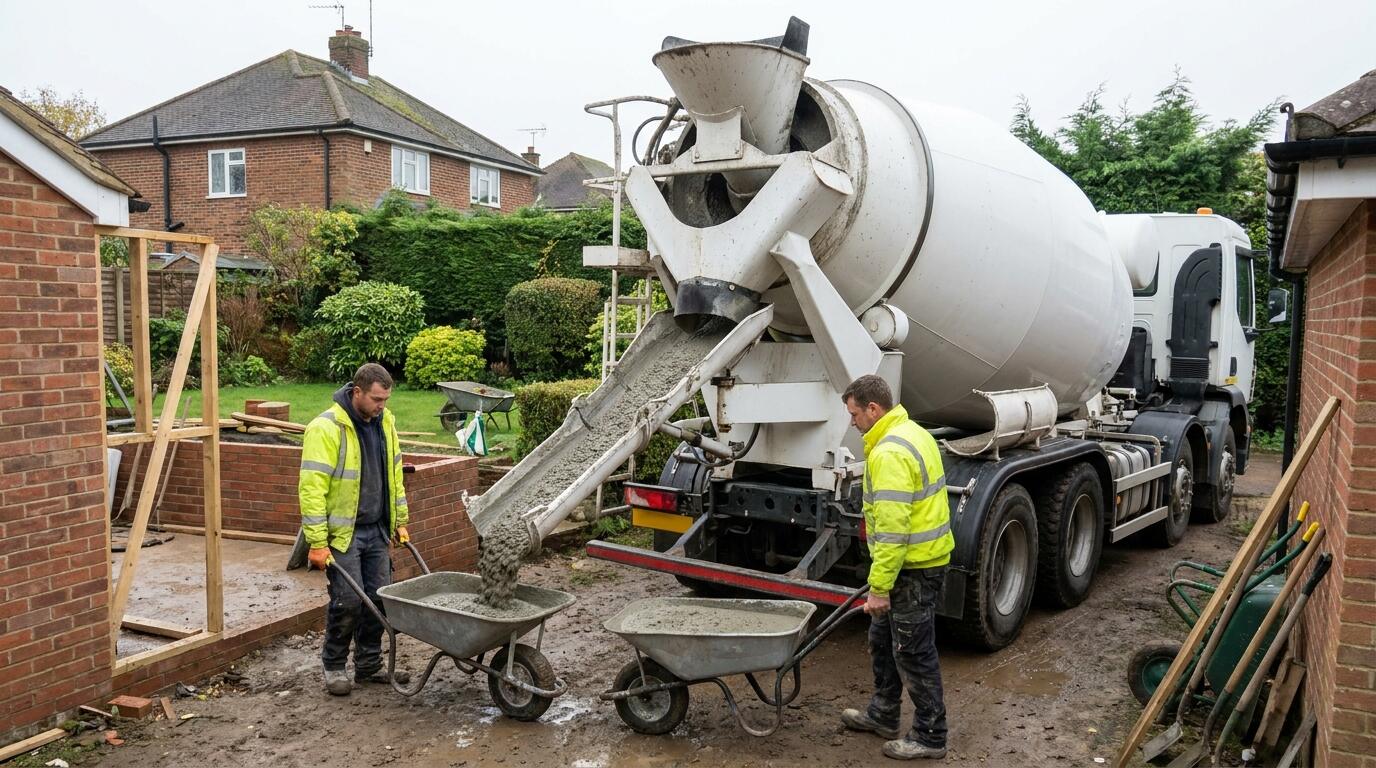
- A builder's barrow holds roughly 60 to 80 litres of concrete, so a cubic metre is somewhere between 13 and 17 barrow loads. Two people can barrow a couple of cubic metres in the time the truck allows; beyond that, think about a pump.
- A 25kg bag of cement with ballast at a 1:6 mix makes roughly 0.1 cubic metres, so a 2.7 cubic metre garage slab is about 27 bags of cement and nearly two tonnes of ballast mixed by hand. That is the point at which ready-mix wins.
Bring your dimensions to the counter or read them out over the phone and we will check the arithmetic before anything is ordered. The bricks, blocks and aggregates guide covers the hand-mix quantities if the job really is small.
Footings and foundations
Most of the concrete we send out goes into the ground under an extension. Footings are the one pour you cannot redo, so they are worth getting right, and the sequence is well established.
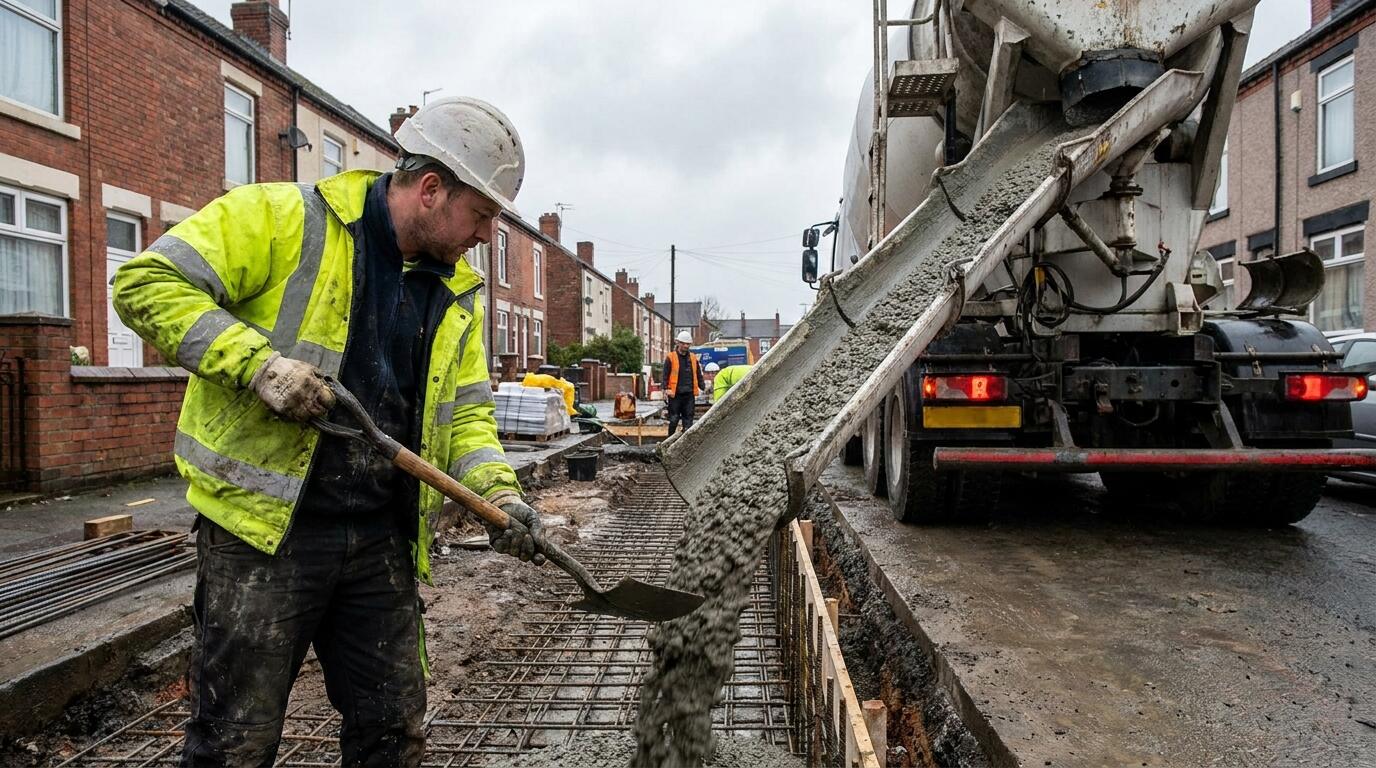
Depth and width come from Building Control, not from a rule of thumb. The inspector will look at the trench before the pour and confirm the bearing is sound; in much of Nottingham that means digging through topsoil and fill to firm clay or sand, and near trees it can mean going deeper than you hoped. Do not pour until the trench has been inspected, and have the concrete booked for after the inspection, not before.
Strip footing or trench fill? A strip footing is a relatively thin band of concrete, typically 200 to 300mm deep, on which brick or block footings are built up to ground level. Trench fill takes the concrete most of the way to the surface, which uses far more concrete but saves days of bricklaying below ground and is the normal choice on domestic extensions now. The volume table above shows the difference: the same 15 metre trench takes 2.25 cubic metres as a strip and 9 as trench fill. Price the two together before you decide.
Mix. GEN1 for normal ground; an FND mix if the ground has sulfates, which the inspector or a soil report will tell you. Where the trench runs past a drain, a lintel or a sleeve over the pipe keeps the concrete off it.
On the day. Set level pegs in the trench so the top of the concrete comes out flat and at the right height for the first course of blocks; a footing that is 30mm out at one end costs a course of cut blocks all the way round. Pour from one end, work the concrete into the corners with a shovel and tamp it lightly to get the air out. In dry weather, cover it or spray it; in cold weather, do not pour below about 5°C and falling, because the concrete will not gain strength and frost will damage it. The drainage guide covers what to do where drains cross the footing line.
Slabs, garage floors and driveways
Floor slabs and drives are where the finish shows, so preparation and placing matter more than they do in a trench.
Sub-base. A slab sits on compacted hardcore, usually MOT Type 1, at least 100mm thick and whacked down in layers with a compactor plate. Blind the top with sand so the damp-proof membrane is not punctured, lay the DPM with generous laps, and turn it up at the edges. Skimping here is what makes a garage floor crack along a line six months later.
Thickness and reinforcement. A shed base or path at 100mm in GEN3 is fine. A garage floor or house oversite is normally 150mm; add A142 mesh on spacers if a car or anything heavier will stand on it, and switch to an RC mix. A driveway in Nottingham, which gets frost and gritting salt, wants PAV1 at 150mm minimum with mesh, over a proper sub-base.
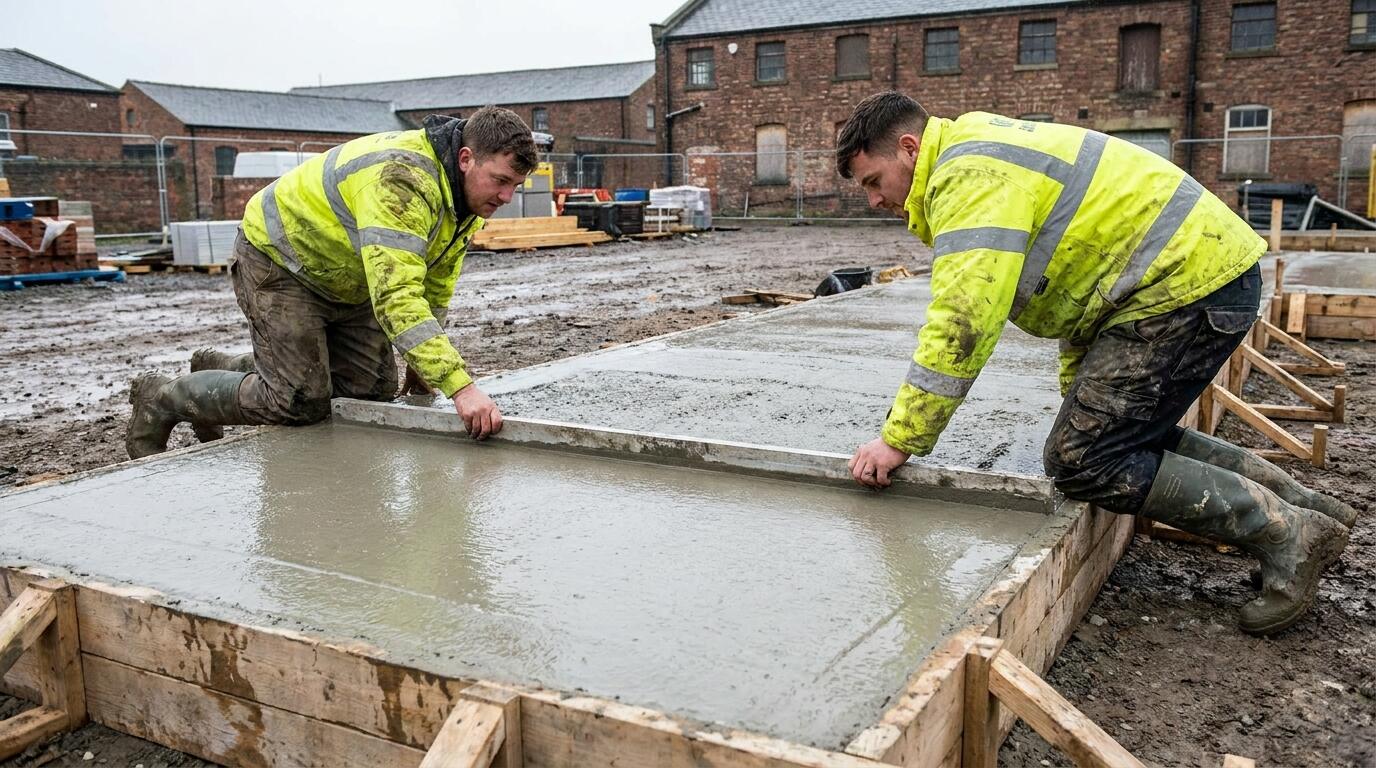
Shuttering and joints. Fix timber shuttering to the finished level, check it for level and for square, and grease it so it strips cleanly. A slab larger than about 4 to 5 metres in any direction, or an L-shaped one, needs movement joints so it cracks where you want it to rather than where it likes; either form them with a fillet or cut them with a saw the next day, about a quarter of the slab depth.
Placing and finishing. Get the concrete in fast and level it with a screed board across the shutters, then tamp to bring up the fines. For a garage or house floor that will be covered, a tamped or float finish is enough. For a drive, a brushed finish gives grip; float it first, let it stiffen, then draw a stiff broom across it in one direction. Do not overwork the surface or add water to make it easier; both weaken the top.
Curing. Keep the slab damp and covered with polythene for a few days so it does not dry too fast. Foot traffic after a day or two, light loads after a week, a car on a drive after at least a week and ideally longer, full strength at 28 days. The paving and landscaping guide covers the sub-base for a drive or patio in detail.
Small loads, post bases and garden jobs
Not every job needs a full mixer. A run of fence posts in Bulwell, a base for a hot tub in Beeston, a few steps and a path in Arnold, a small conservatory footing in Wollaton: these are half a cubic metre to two cubic metres, and they sit awkwardly between "mix it yourself" and "order a lorry".
The options are:
- Bagged materials. Under about half a cubic metre, buying cement and ballast (or ready-bagged post mix for fence posts) and mixing in a hired mixer is realistic. It is hard work but flexible, and the yard stocks everything you need, with mixers on tool hire.
- A small ready-mix load. Ready-mix suppliers can deliver small quantities, but a part-load usually carries a charge because the truck still has to make the trip. It is often still cheaper than a day of your own labour, and the concrete is better. Tell us the volume and we will quote it honestly.
- Volumetric delivery. Some concrete is delivered by a truck that carries the ingredients separately and mixes on site, so you pay for what is used and the mix can be adjusted on the spot. Whether that is what turns up depends on the job and the supplier's fleet; ask which vehicle will come when you book.
Small loads have their own practicalities. If the pour is in a back garden, the truck stops in the road and everything goes through the house or down a side passage in barrows, so line the route with boards and dust sheets and have enough people. Fence posts want a stiff mix so the post stays put while it sets; tell us they are for posts. And a small volume of concrete goes off just as fast as a big one, so be ready before the truck arrives rather than digging the last hole while it waits.
If the job is small and the access is difficult, say so when you ring and we will help you decide between a delivery and a pile of bags. We would rather sell you the right thing.
Preparing the site and access for the truck
A concrete mixer truck is the largest vehicle most domestic sites ever see. A full-size mixer with a full drum can weigh well over 25 tonnes, stands around 2.5 metres wide before its mirrors and close to 4 metres tall, and needs a clear, firm route to where it will discharge. Almost every problem with a concrete delivery is an access problem that nobody mentioned when booking.
Before the truck arrives:
- Decide where it will stand. On the road is the default in a terrace in Radford or Sherwood; onto a drive only if the drive will take the weight. The chute on a mixer reaches roughly 3 metres from the back of the truck, and extension chutes add a little; beyond that it is barrows, a dumper or a pump.
- Clear the route. Cones or a car to hold the space in the road, cars moved off the drive, the side gate open, wheelbarrow runs laid with boards over the lawn and through the house. The truck will not drive on pavements, verges or lawns, and should not drive over manhole covers or a drive with a soft base.
- Check overhead. Telephone wires, tree branches and a low porch will stop a truck that needs to raise its chute or is simply taller than the gap.
- Have the people and the kit ready. Enough barrows and enough hands, shovels, a rake, a screed board, a tamper, a float and a broom for a drive, and the shuttering and mesh already in place. Concrete waits for nobody.
- Check the weather. Do not pour onto frozen ground or when frost is forecast overnight without protection; in hot sun, have polythene or hessian ready to cover the slab.
Concrete should be placed within about two hours of being batched, and the truck's time on site is limited, so a pour that drags on because the barrows could not keep up may incur waiting time. Ask about that when you book so there are no surprises. If the pour is more than a couple of cubic metres and the truck cannot get within chute reach, a line pump is worth the cost: it puts the concrete exactly where you want it, quickly, with two people instead of six.
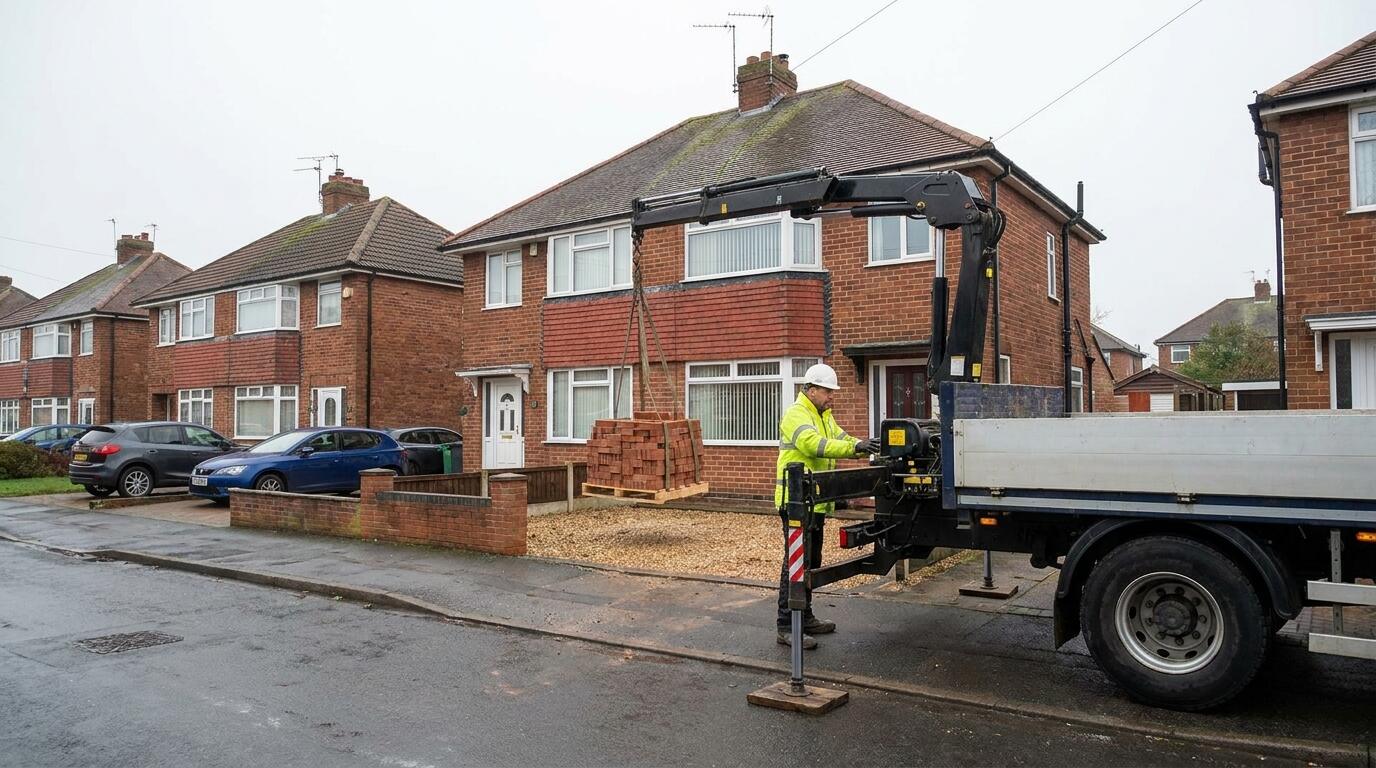
Much of this applies to any heavy delivery, and the building supplies delivery page goes into vehicles and access more generally. If you are unsure whether a truck can reach your site, describe it or send a photo and we will tell you before you book.
Ordering concrete and what happens next
When you have the mix, the volume and a plan for the truck, booking is a phone call. Ring the yard on 0115 929 2350 between 8:00am and 5:00pm Monday to Friday or 7:30am and 12:30pm on Saturday, or send an enquiry with the details and we will respond within 24 hours. For trade customers, concrete can go on the account with the rest of the job.
Give us a day's notice where you can, more for a large pour or a specific mix, and tell us if the timing depends on a Building Control inspection so we can hold a slot rather than fix one. If the inspection throws up extra depth, ring and we will adjust the volume; it is far better to change the order the day before than to be short on the day.
On the day:
- Be on site and ready before the truck's window, with the access clear and someone to direct the driver.
- Check the delivery ticket against what you ordered: mix designation, volume and any admixtures such as a retarder or fibres.
- Place the concrete without adding water to the drum. Extra water makes it easier to move and permanently weaker; if it needs to be wetter for pumping or a long barrow run, that should be specified in the mix when you book.
- Wash tools and barrows straight away, and do not wash out into a drain; a heap on the hardcore or a spare bit of trench is fine.
Concrete is usually one part of a bigger order. The trench blocks and DPC for the footings, the mesh and DPM for the slab, the Type 1 for the sub-base and the timber for the shuttering can all be delivered ahead of the pour, and a skip for the spoil booked for the same week. Send us the whole list and we will price and sequence it, so the concrete arrives when the trench is ready and not the day before the digger.
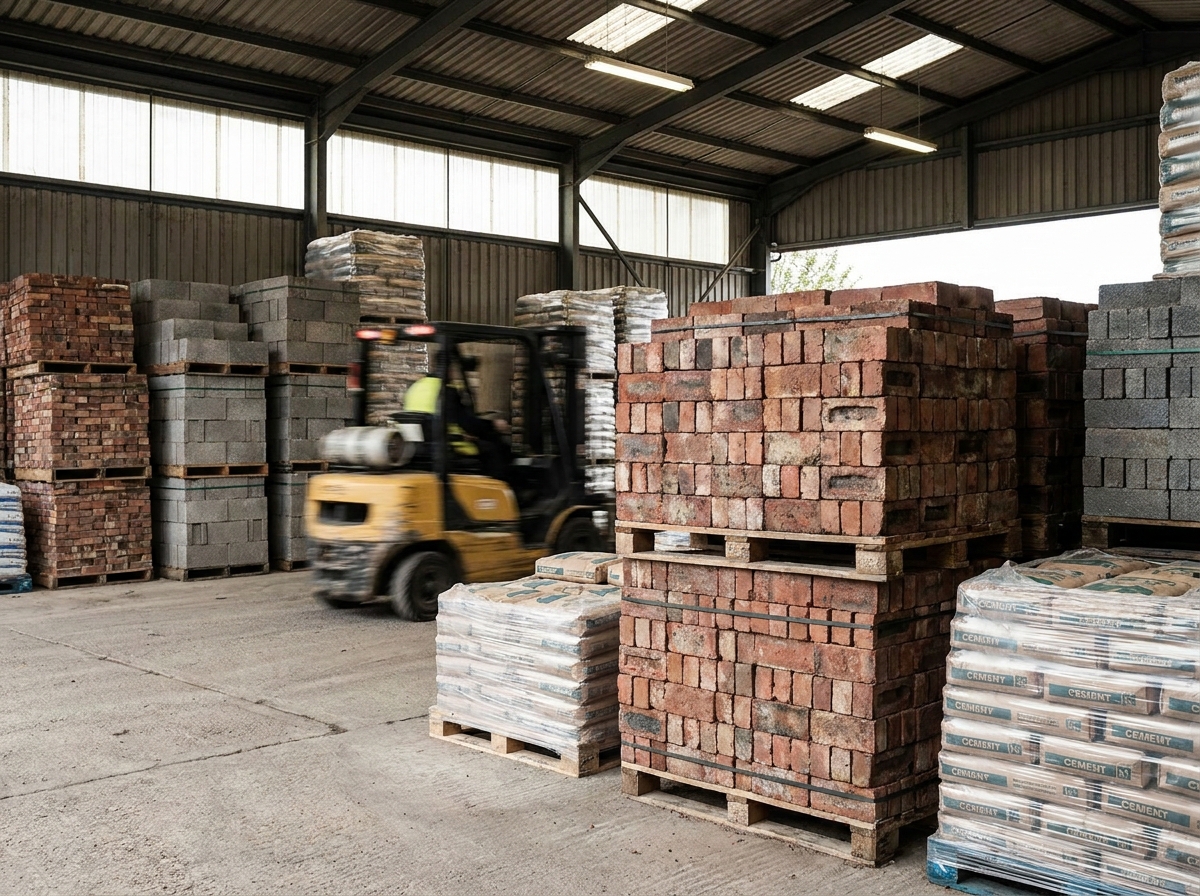
The full range of what we supply is under products, and the builders merchant page explains how the yard works if you have not used us before.
Last updated 2026-08-29. Stock, sizes and availability change; call 0115 929 2350 to check before you set off.