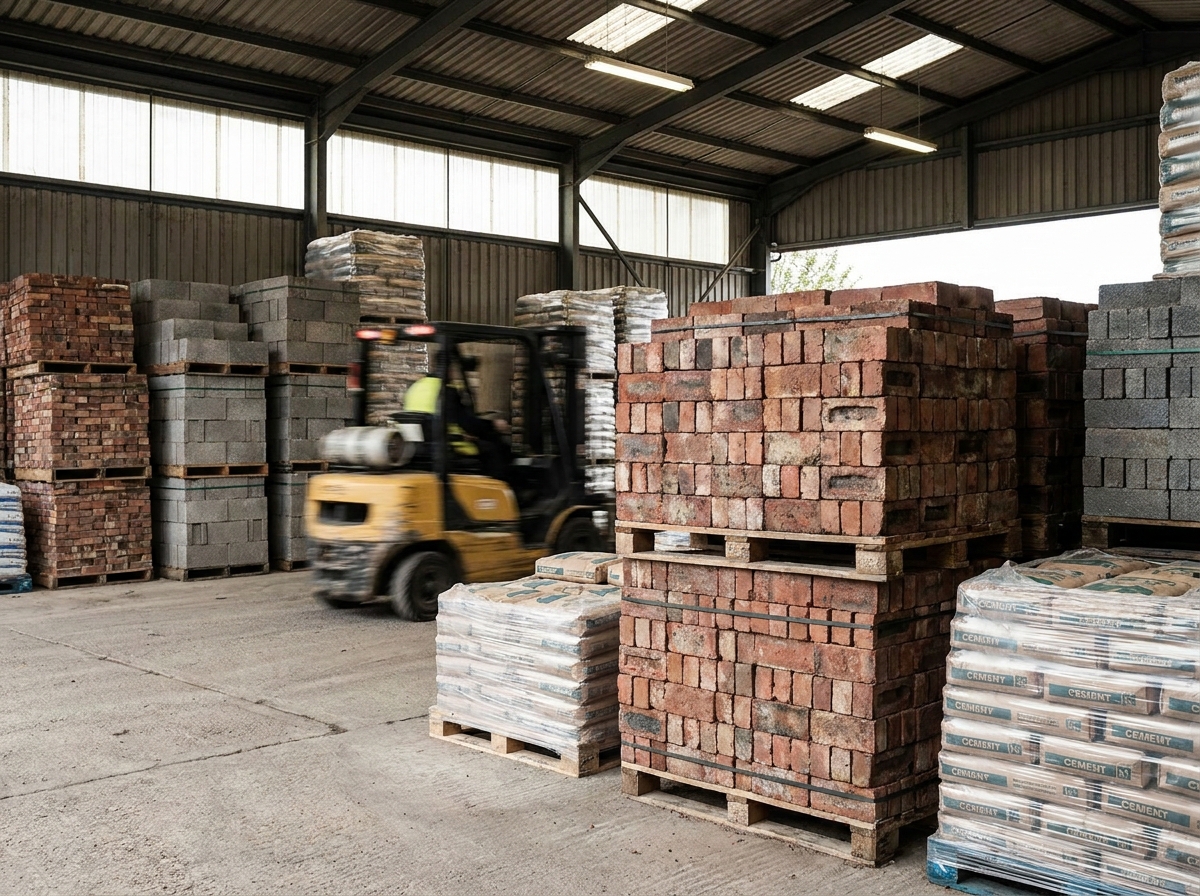
Bricks, blocks and aggregates are the least glamorous things we sell and the ones people most often get wrong. A wall built from the wrong brick spalls in its first winter; a garage floor laid on unconsolidated sand cracks; a patio ordered on guesswork ends with a second delivery charge for one bag of sand. The numbers below are standard UK practice. Where a figure depends on the job, we say so and give a range. If you would rather talk it through, ring 0115 929 2350 or bring a sketch to the yard at Bobbers Mill.
On this page
- 1.Facing, engineering and common bricks: what each is for
- 2.Frost resistance and durability: reading F2/S2
- 3.Brick sizes and how many you need per square metre
- 4.Concrete blocks: 3.6N, 7.3N, dense, lightweight and aircrete
- 5.Mortar mixes and how much sand and cement to order
- 6.Sand, ballast, gravel and MOT Type 1: which aggregate does what
- 7.Bulk bag coverage: worked examples
- 8.Mixing concrete from ballast, and when to call for ready-mix
- 9.Matching bricks on Nottingham’s Victorian and 1930s houses
- 10.Buying bricks, blocks and aggregates from the yard
- 11.Frequently asked questions
Facing, engineering and common bricks: what each is for
Nearly every clay brick you will buy falls into one of three groups, and the group tells you where it can go.
Facing bricks are the ones you see. They are made to look right and to stand up to weather on the outside of a wall. Colour, texture and size vary enormously: smooth reds, sand-faced multis, wire-cut, handmade and stock bricks, plus modern reclaims and imperial-sized bricks for older properties. Strength is rarely the issue with a facing brick on a house; durability and appearance are, which is why the frost-resistance rating (covered in the next section) matters more than the crushing figure.
Engineering bricks are dense, strong and absorb very little water. They are classified to BS EN 771-1 as Class A or Class B:
| Class | Minimum compressive strength | Maximum water absorption | Typical use |
|---|---|---|---|
| Class A | 125 N/mm² | 4.5% | Heavy civil work, retaining walls, manholes, DPC courses in exposed positions |
| Class B | 75 N/mm² | 7% | Below DPC on houses, piers, copings, steps, inspection chambers, anywhere wet |
Class B is the everyday engineering brick and is what most domestic jobs need. Blue engineering bricks are the classic version; red engineering bricks are common where the brick will be seen above ground.
Common bricks are made for strength and economy rather than looks. They go where they will be rendered, plastered or hidden inside a wall. They are less common now that blocks do most of that work, but they still have a place in repairs and in matching older internal walls.
The short version: facings above ground where you can see them, engineering below the damp-proof course and anywhere that stays wet, commons where nobody will ever look. The yard at Bobbers Mill holds all three, and we can order specific facings for a match.
Frost resistance and durability: reading F2/S2
Every clay brick sold in the UK carries a durability designation made of two parts: an F number for freeze-thaw resistance and an S number for soluble salt content. You will see it written as F2S2, F1S2 and so on. It is the single most useful thing to check before you buy a facing brick.
| Code | Meaning | Where it can be used |
|---|---|---|
| F0 | Passive exposure only | Internal walls, fully protected work |
| F1 | Moderate exposure | External walls above DPC that stay reasonably dry; not for copings, sills or below ground |
| F2 | Severe exposure, frost resistant | Anywhere, including below DPC, free-standing walls, copings, retaining walls, planters |
| S0 / S1 / S2 | Soluble salt content, high to low | S2 (low salts) reduces the risk of efflorescence and sulphate attack on mortar |
Why it matters here: a garden wall is wet from both faces, has a coping on top and its base in the ground. It is as exposed as a brick gets. Use an F1 facing brick on it and the faces will start to spall (the surface blows off in flakes) after a couple of hard winters. The same brick on a house wall under an overhanging roof, above a DPC, may be fine for a century. That is the difference between moderate and severe exposure.
Practical rules that follow from this:
- Free-standing garden walls, retaining walls, planters and anything below DPC: F2S2 facings or Class B engineering bricks.
- Copings and sills: F2 bricks or purpose-made coping units, always with a DPC underneath.
- House walls above DPC in Nottingham's climate: F1 is acceptable, F2 is safer, and most modern facings are F2 anyway.
- Reclaimed bricks carry no rating. Assume F1 at best and keep them above DPC unless you know their history.
Engineering bricks are F2S2 by their nature, which is why they end up as the two courses below DPC on nearly every house in the city.
Brick sizes and how many you need per square metre
The standard UK metric brick is 215mm long, 102.5mm wide and 65mm high. With a 10mm mortar joint that becomes a 225mm by 75mm module on the face of the wall, and the arithmetic falls out of that.
| Wall type | Thickness | Bricks per m² |
|---|---|---|
| Half-brick wall (stretcher bond) | 102.5mm | 60 |
| One-brick wall (English or Flemish bond) | 215mm | 120 |
| Brick-on-edge coping | per linear metre | about 13 |
| Soldier course | per linear metre | about 9 |
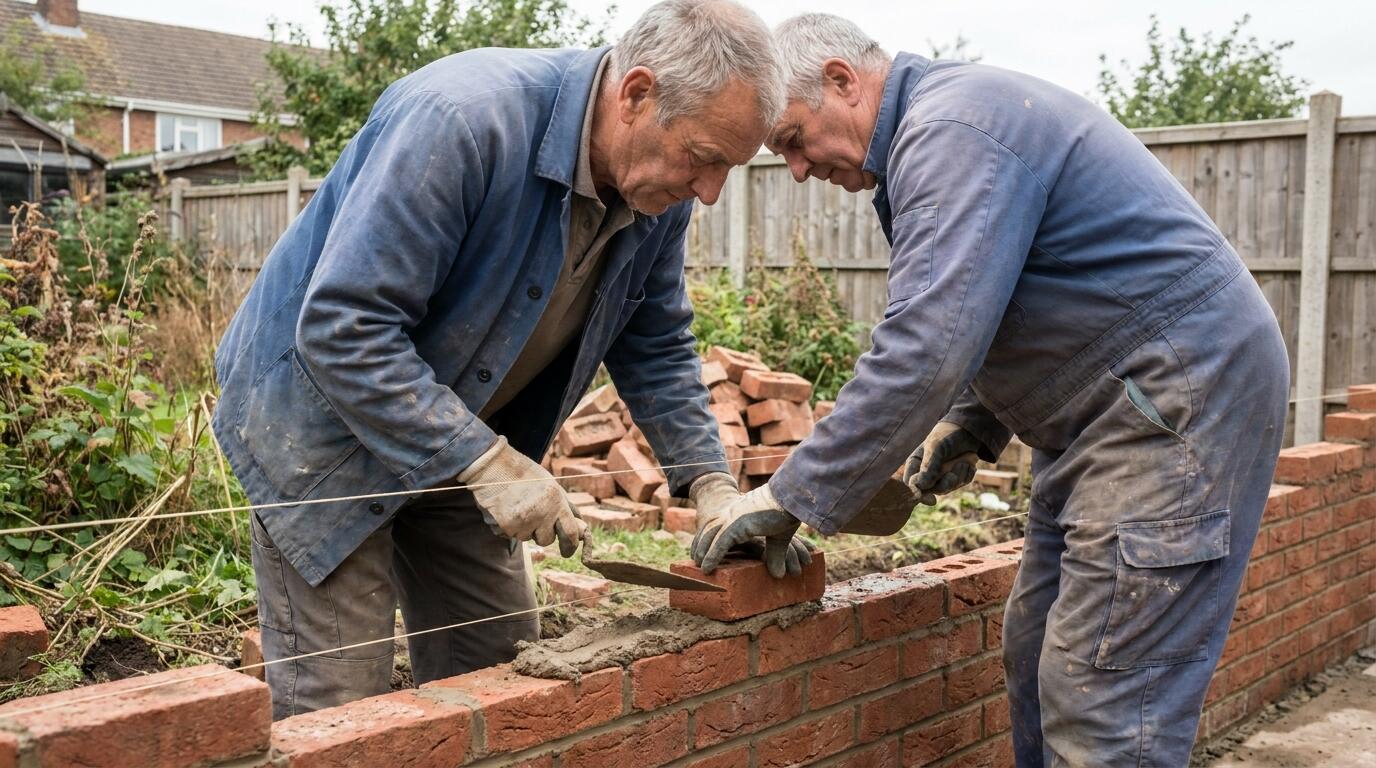
The 60 per square metre figure is the one to remember. It applies to the outer leaf of a cavity wall, a single-skin garden wall, the facing on an extension and most brick repair work. Add 5% for cutting and breakages on plain walls, 10% where there are lots of returns, piers and openings.
Worked example. A garden wall 10m long and 1.8m high in a half-brick wall with a brick-on-edge coping and three 215mm piers:
- Face area: 10 × 1.8 = 18m². At 60 per m² that is 1,080 bricks.
- Coping: 10m at 13 per metre is 130 bricks.
- Piers: each pier adds roughly one extra brick per course beyond the wall; 24 courses × 3 piers × 1 = 72 bricks.
- Subtotal 1,282. Add 7% for waste: about 1,370 bricks.
Older Nottingham houses were built with imperial bricks, typically 68mm or 73mm high rather than 65mm, and often a little longer. That changes the count (fewer per square metre) and, more importantly, means a modern metric brick will not course in with the original. See the section on matching bricks below before ordering for a repair or extension on a pre-war property.
Bricks are sold loose for small jobs and by the pack for larger ones. Pack sizes vary by manufacturer, so tell us the number you need and we will make it up from packs and loose to suit.
Concrete blocks: 3.6N, 7.3N, dense, lightweight and aircrete
The standard block is 440mm long by 215mm high, which with a 10mm joint gives a 450mm by 225mm module and 10 blocks per square metre. Widths are 100mm for most walls, with 140mm and 215mm for load-bearing and party walls and 75mm for non-structural partitions. What changes between blocks is density, strength and how they handle heat and sound.
| Block type | Typical strength | Approx. weight (100mm) | Typical use |
|---|---|---|---|
| Dense aggregate | 7.3N/mm² (10.4N available) | 18–20kg | Below DPC, foundations, retaining walls, garages, anywhere loaded or wet |
| Medium density / lightweight aggregate | 3.6N or 7.3N/mm² | 12–15kg | Inner leaf of cavity walls, partitions, general blockwork above DPC |
| Aircrete (aerated) | 2.9N, 3.6N or 7.3N/mm² | 8–11kg | Inner leaf where thermal performance matters, partitions, easy to cut with a hand saw |
| Foundation aircrete (trench block) | 3.6N or 7.3N/mm² | varies by width | Below DPC as a single wide block instead of two leaves |
3.6N versus 7.3N. The number is minimum compressive strength. 3.6N blocks are adequate for most walls in a two-storey house above DPC. 7.3N is specified below DPC, under heavy point loads (beam bearings, padstones), for walls carrying more than two storeys and for retaining walls. If a structural engineer's drawing or a Building Control officer says 7.3N, that is not negotiable. If nothing is specified and the block is going below ground, use 7.3N dense anyway.
Thermal blocks. Aircrete has far lower thermal conductivity than dense concrete, which is why it is used on the inner leaf of new cavity walls to help meet Part L. It is also lighter to lay, which bricklayers notice by mid-afternoon. It is not a substitute for insulation; it works alongside the cavity insulation covered in our plasterboard and insulation guide.
Blocks are sold by the pack. Where you only need a few dozen we will split packs, and where the job is a full inner leaf we will deliver by the pallet to the nearest safe point on site.
Mortar mixes and how much sand and cement to order
Mortar is proportioned by volume. The standard UK designations run from the strongest (i) to the weakest general-purpose mix (iv), and the rule is to use the weakest mortar that suits the exposure so that the joint, not the brick, gives way if anything moves.
| Mix (cement : lime : sand) | Cement : sand with plasticiser | Designation / class | Use |
|---|---|---|---|
| 1 : ¼ : 3 | 1 : 3 | (i) / M12 | Engineering brick below ground, copings, retaining walls in severe exposure |
| 1 : ½ : 4½ | 1 : 3–4 | (ii) / M6 | Below DPC, parapets, free-standing walls, chimneys |
| 1 : 1 : 6 | 1 : 5–6 | (iii) / M4 | General brickwork and blockwork above DPC; the everyday mix |
| 1 : 2 : 9 | 1 : 7–8 | (iv) / M2 | Internal walls, soft or reclaimed bricks, lime-rich pointing |
The lime in a 1:1:6 makes the mortar workable and slightly flexible. A liquid plasticiser does the same job for workability, which is why most bricklayers now use a 1:5 or 1:6 cement and sand mix with plasticiser in the water. Either is correct above DPC. Never use washing-up liquid; it entrains far too much air and the mortar will be weak and frost-prone.
Use building sand (soft sand) for bricklaying and pointing, not sharp sand. The rounded grains give the buttery workability a trowel needs. Sharp sand mortar is harsh, hard to spread and is for floor screeds and paving beds.
How much to order. The trade rule of thumb, allowing for frogs, waste and droppings, is:
- 1,000 bricks need roughly one bulk bag of building sand and 6–8 bags of cement (25kg bags) at 1:5 or 1:6.
- The same bulk bag of sand lays in the region of 600 blocks (100mm) with 6 bags of cement.
- Per square metre: about 0.02–0.03m³ of mortar for a half-brick wall, 0.01m³ for 100mm blockwork.
For the 1,370-brick garden wall in the example above, that is one and a half bulk bags of building sand and 10 bags of cement, plus plasticiser. Cement keeps for about three months if stored dry, so do not stockpile it. Do not lay when the temperature is 3°C and falling, and cover fresh work in frost and heavy rain.
Sand, ballast, gravel and MOT Type 1: which aggregate does what
The aggregate bays at the yard look similar and behave very differently. Choosing the wrong one does not always fail straight away, which is worse than failing immediately.
- Building sand (soft sand). Fine, rounded grains. Mortar for bricks and blocks, pointing, bedding coping stones. Not for concrete or screed.
- Sharp sand. Coarse, angular, gritty. Concrete, floor screeds, paving beds under slabs, laying course under block paving, mixing with topsoil to improve drainage. Not for bricklaying.
- Plastering (rendering) sand. Clean, washed and graded for external render and internal float coats. Building sand can be used for render but a proper plastering sand gives a more consistent finish.
- Kiln-dried sand. Bagged, bone dry, very fine. Brushed into block paving joints. Nothing else.
- Ballast (all-in aggregate). Sharp sand and 20mm gravel pre-mixed, typically 0–20mm. Concrete for footings, post bases, shed bases and haunching kerbs.
- Gravel and shingle. 10mm (pea gravel) for pipe bedding and drainage; 20mm for concrete, drives and decorative use. Rounded pea gravel rolls under foot and is not good on a drive; angular gravel locks together.
- MOT Type 1. Crushed limestone or granite graded from 40mm down to dust, so it compacts into a hard, stable layer. Sub-base for drives, paths, patios, shed bases and under concrete slabs. Type 3 is a reduced-fines version used where a permeable sub-base is wanted.
- Hardcore. Crushed brick and concrete. Cheaper fill for raising levels and under oversite, but it does not compact as reliably as Type 1 under paving.
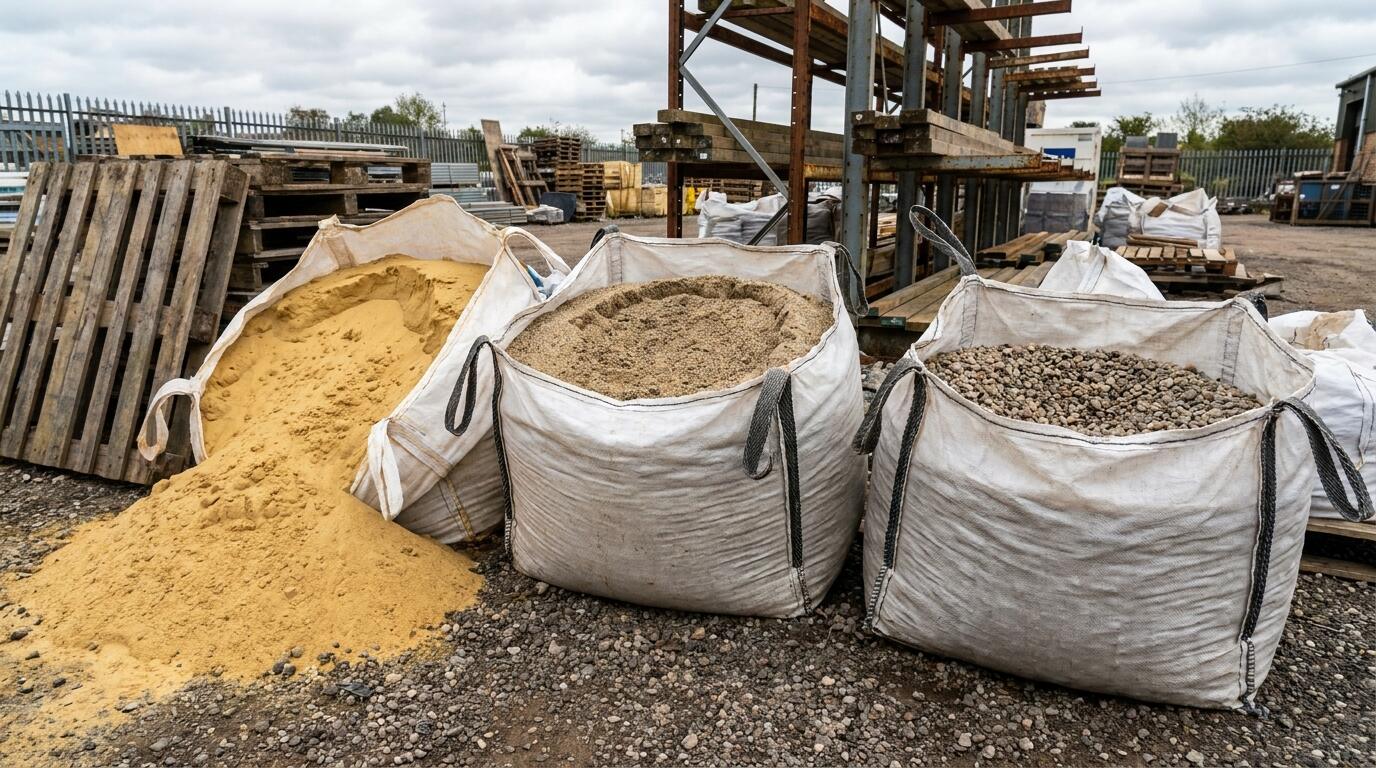
Two mistakes we see most often: using building sand under paving (it holds water and stays soft) and using pea gravel as a sub-base (it never compacts). Sub-base and bedding for hard landscaping are covered in detail in the paving and landscaping guide, and pipe bedding in the drainage guide.
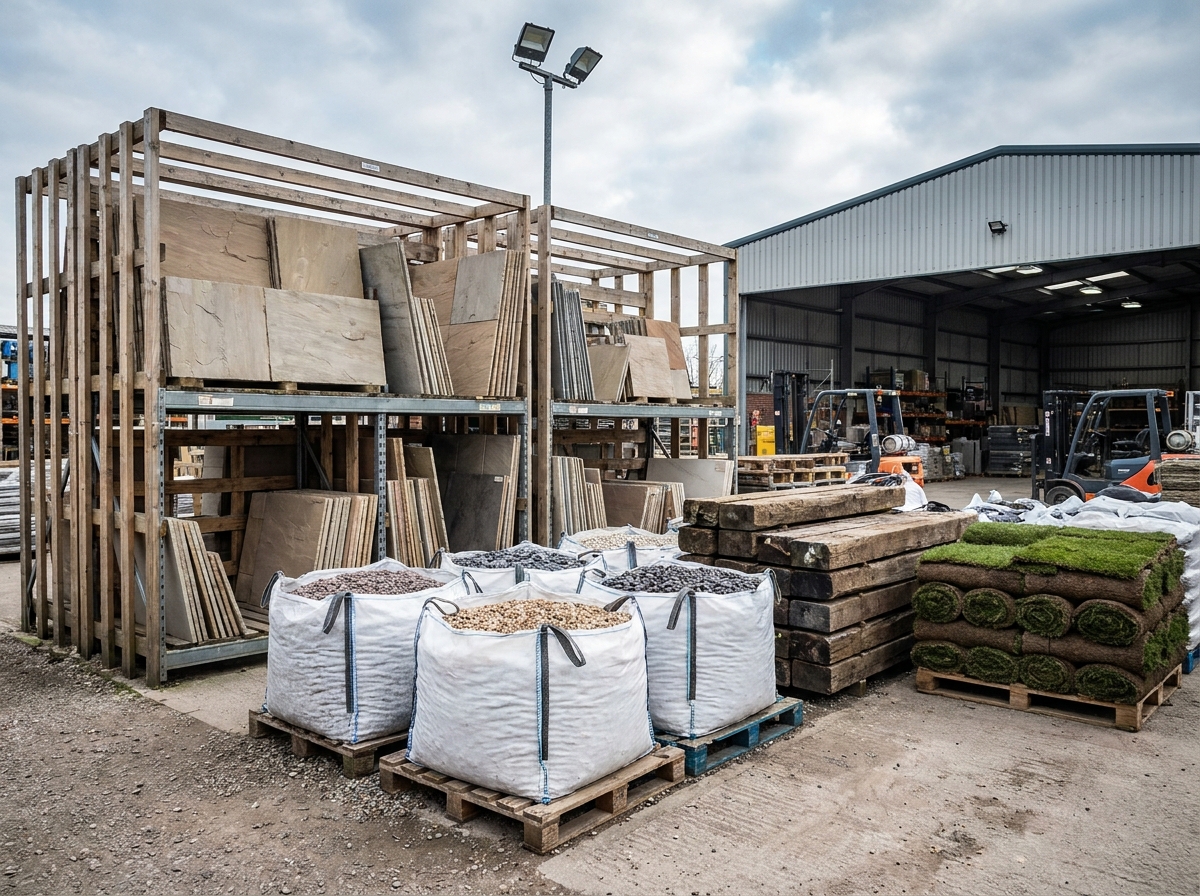
Everything above is sold in 25kg bags for small jobs and in bulk bags for anything bigger. Bags are easier to carry through a house; bulk bags need somewhere a lorry with a crane or a forklift can set them down.
Bulk bag coverage: worked examples
A bulk bag (jumbo bag, tonne bag) is filled by weight, not to the brim. Most hold around 800–850kg; the bag itself has a nominal capacity of about 0.7–0.8m³ but is rarely full. For sand, gravel and ballast that weight is roughly half a cubic metre of loose material. MOT Type 1 is denser and compacts further, so the same weight covers less ground.
| Material (one bulk bag, ~850kg) | Loose volume | Covers approximately |
|---|---|---|
| Building sand for mortar | 0.5–0.55m³ | About 1,000 bricks or 600 blocks |
| Sharp sand as a 40mm paving bed | 0.5–0.55m³ | 12–13m² |
| Sharp sand as a 50mm block-paving laying course | 0.5–0.55m³ | 10–11m² |
| 20mm gravel at 50mm deep | 0.55m³ | 10–12m² |
| 10mm pea gravel as 100mm pipe bedding | 0.55m³ | About 10–12 linear metres of 110mm pipe (bed and surround) |
| MOT Type 1 at 100mm compacted | 0.45–0.5m³ loose | 4–5m² |
| MOT Type 1 at 150mm compacted | 0.45–0.5m³ loose | About 3m² |
| Ballast for 1:6 concrete | 0.5m³ | About 0.5m³ of concrete with 5–6 bags of cement |
Worked example: a 4m by 5m patio. Area 20m². Sub-base at 100mm compacted needs 20 × 0.1 = 2m³ compacted, and Type 1 compacts by about 20–25%, so order 2.5m³ loose: 5 bulk bags of Type 1. The 40mm sharp sand and cement bed needs 20 × 0.04 = 0.8m³, so 2 bulk bags of sharp sand with around 8 bags of cement at 5:1. If you only order four bags of Type 1 you will run out with three square metres to go, which is the phone call we get every Saturday.
Worked example: a 6m by 1.5m gravel path. Area 9m². MOT Type 1 at 75mm compacted: 9 × 0.075 = 0.68m³ compacted, order 0.85m³ loose, 2 bulk bags. 20mm gravel at 50mm: 9 × 0.05 = 0.45m³, 1 bulk bag with a little left over. Add a woven membrane between the two.
Round up, not down. Aggregates keep, and a part bag left in the corner costs a lot less than a second delivery. If the sums are getting complicated, send us the dimensions and we will do them.
Mixing concrete from ballast, and when to call for ready-mix
For post bases, a small shed base, a step or a kerb haunch, hand-mixed concrete from ballast and cement is quick and cheap. For anything bigger, it stops being either.
| Mix by volume | Roughly equivalent to | Use |
|---|---|---|
| 1 cement : 6 ballast | C15–C20 | General purpose: post bases, haunching, blinding, small shed bases |
| 1 cement : 5 ballast | C20–C25 | Garage floors, paths, slabs that carry a car |
| 1 cement : 4 ballast | C25–C30 | Small footings, steps, anything Building Control will look at (confirm the specified grade) |
| 1 cement : 2 sharp sand : 4 gravel | C25 | The same as 1:5 ballast but mixed from separate aggregates for better control |
A bulk bag of ballast with 5–6 bags of cement gives about half a cubic metre of 1:6 concrete. A standard 25kg bag of cement with 150kg of ballast (six 25kg bags) gives about 0.1m³. A single fence post hole 300mm square and 600mm deep, with a 100mm post in it, needs about 0.05m³, so one bag of cement and six of ballast does two posts with a little to spare.
Add only as much water as makes the mix workable; a sloppy mix is a weak mix. Keep new concrete damp and covered for a few days in hot weather and protected from frost in cold.
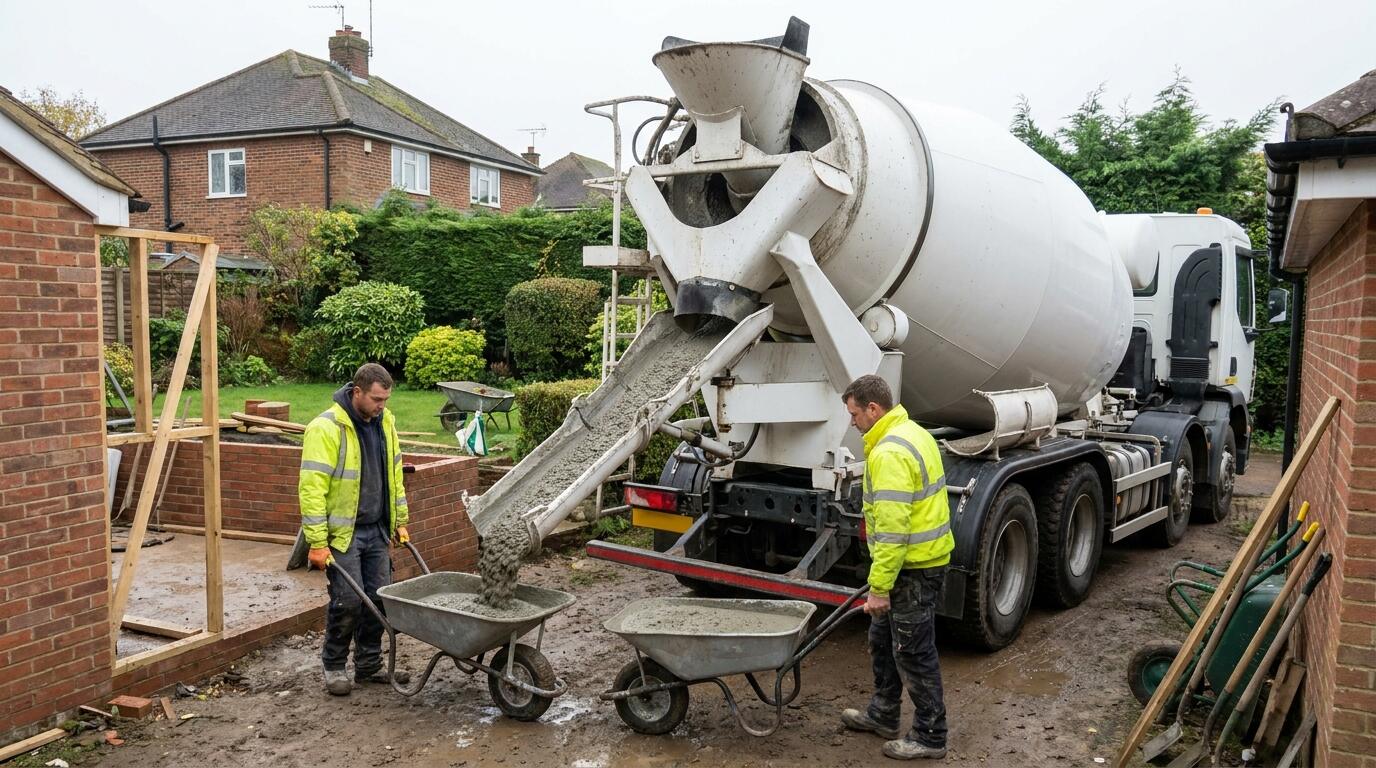
When to stop hand-mixing. Above about a cubic metre, a mixer and two people will spend most of a day producing what a truck delivers in twenty minutes, and the strength will be inconsistent batch to batch. Strip footings for an extension, a full garage slab, a large driveway base or anything that needs a specified grade for Building Control should be ready-mix concrete delivered to site, which we arrange from the same counter. A 6m by 3m extension with 600mm wide by 300mm deep strip footings on three sides is 12m × 0.6 × 0.3 = 2.2m³: a ready-mix job, not a wheelbarrow one.
Matching bricks on Nottingham’s Victorian and 1930s houses
A large share of the housing across Radford, Hyson Green, Sherwood, Carrington, Basford and Beeston is Victorian or Edwardian terracing in local red brick, and the ring of semis from Aspley out to Wollaton, Bilborough and Arnold went up between the wars. Both cause the same problem for an extension or a repair: the original brick is no longer made, and the nearest modern equivalent will not match on colour, texture or size unless someone chooses it carefully.
Victorian and Edwardian brick. Usually a soft-ish, orange-red pressed or wire-cut brick in imperial sizes, often 73mm high, sometimes with a deep frog. The fronts of better terraces used a smoother, redder facing with the cheaper brick on the sides and rear. The pointing was lime, and often a struck or weathered joint rather than a bucket-handle. Repointing these walls with a strong cement mortar traps moisture and accelerates decay of the brick face; a 1:2:9 or a lime mortar is kinder.
1930s brick. The interwar semis typically used a multi-coloured or rustic red facing, frequently with a sand face, and many were built with a mix of imperial and early metric sizes. Bay fronts sometimes used a different, better facing to the rest. Rendered upper storeys hide commons.
How we match. Bring a whole brick if you can (a broken one shows the body colour but not the face), or a clear photograph in flat daylight with something for scale. We compare it against samples from the manufacturers who still make imperial and traditional facings, and where a brick cannot be matched from current production we can look at reclaimed stock. It usually takes a few days to get samples in. The same applies to roof tiles on these houses; see matching tiles in the roofing guide.
Two practical tips. Order the whole extension's facings from one batch, because two deliveries of the same brick from different kilns can differ visibly. And if a perfect match is not possible, a deliberate contrast (a plinth course, a change at a movement joint) looks better than a near miss.
Buying bricks, blocks and aggregates from the yard
We hold facings, engineering bricks, dense and lightweight blocks, aircrete, sand, ballast, gravel, MOT Type 1, cement, lime and plasticiser at Whitemoor Lodge on Nuthall Road, and we have done since the firm started supplying Nottingham's builders in 1890. Stock changes, so ring 0115 929 2350 to check a specific brick or block before you set off.
Collecting. Bagged aggregates, cement and small quantities of bricks and blocks go in a car or van. Bricks are heavy: 500 facings weigh over a tonne, so a standard van is at its limit well before it is full. We load with the forklift and will tell you honestly what your vehicle can take.
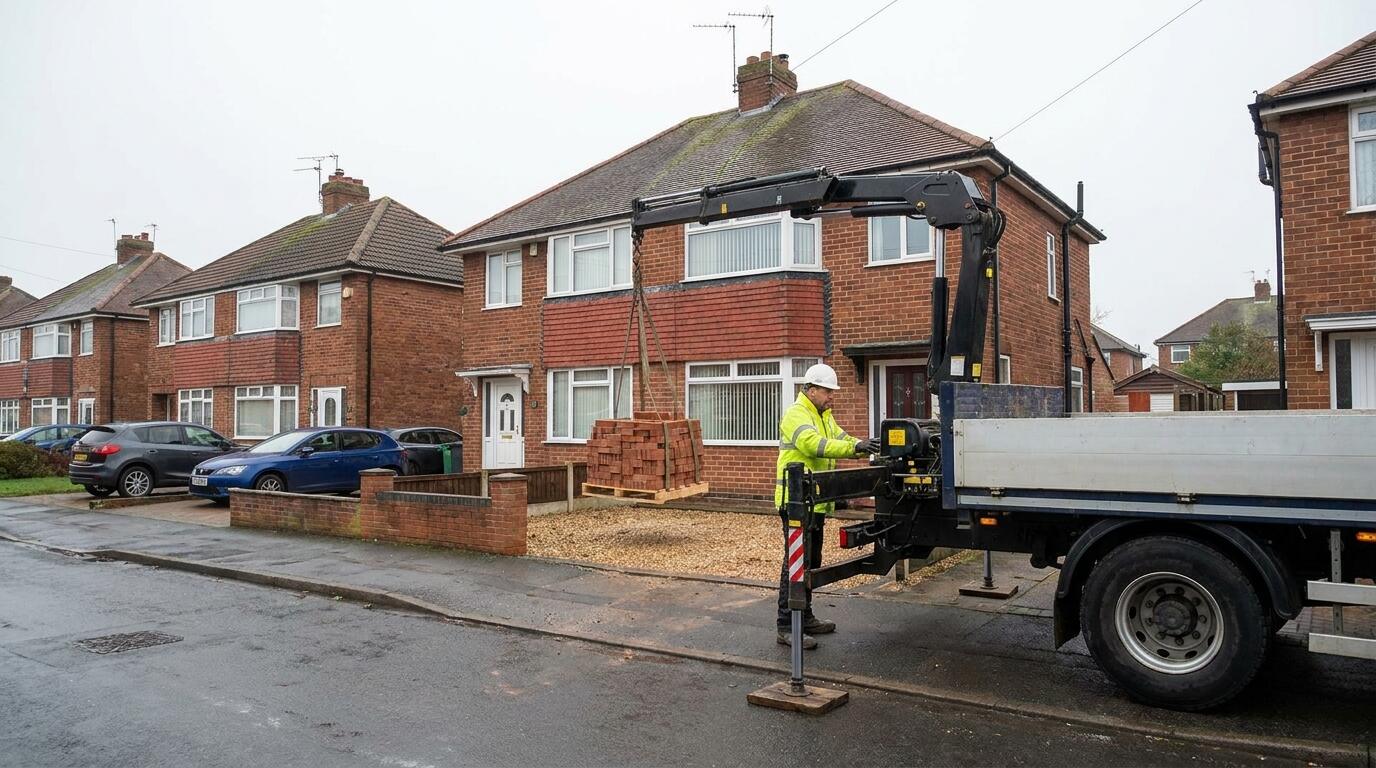
Delivery. Packs of bricks, pallets of blocks and bulk bags are delivered fast across Nottingham and the surrounding area on a vehicle with a crane arm or a forklift, set down as close to the work as access allows. Tell us about parking restrictions, narrow drives and overhead cables when you order. The delivery page explains how it works.
Quantities. Bring dimensions and we will work them out with you using the same figures as this page, then add sensible waste. We would rather you had a part bag left than a lorry back for one more.
Pricing. Everything is quoted for the job. Send a list through the contact form with the site postcode and we will come back with materials and delivery together. Trade accounts are available for regular customers. The wider range, from lintels and wall ties to DPC and cavity trays, is on the products section, and the yard, hours and directions are on the builders merchant page.
Last updated 2026-08-29. Stock, sizes and availability change; call 0115 929 2350 to check before you set off.